How customer feedback helped shape our latest feature and why we think involving customers throughout development is so important.
At Coral Starfish, customer experience has always been one of the most important things we consider when developing our product.
For those unfamiliar with Coral Starfish, we’re a recruitment technology company helping recruitment and executive search professionals work more efficiently by connecting platforms such as LinkedIn, XING and BoardEx with leading CRM systems including Bullhorn, Invenias and Salesforce. Our Chrome extension makes it easier to access, create and update CRM records while working on external platforms, reducing manual data entry and the need to constantly switch between systems.
Turning customer feedback into better recruitment technology
It’s easy to say that you put customers first, so a lot of people claim they do this. For us, the real challenge is making sure that customer experience influences the decisions we make, from the early stages of development to the feedback received when a new feature is being used.
We recently launched our new contact enrichment feature, allowing users to find email addresses and phone numbers directly from the websites they’re already using, all built into the existing workflow of our product.
Involving customers from the beginning
We decided to run a pilot programme with a small group of customers before we even started developing the feature. We had to decide how many companies to work with and how to gain a range of feedback from customers with differing needs, whilst making sure we could manage the feedback being received without being overwhelmed.
We chose to work with a dozen companies, including businesses of different sizes. Some customers were invited directly, while others were suggested by the Bullhorn team.
We also included a couple prospective customers who were trialling Coral Starfish for the first time. This was particularly useful because existing customers already have an understanding of how our product works, whereas someone completely new to Coral Starfish doesn’t have that same familiarity.
Throughout the pilot we gathered feedback through emails, meetings and screen shares, giving customers the opportunity to try the feature and tell us what they thought.
Some of that feedback confirmed things we already believed were important, but other suggestions led us to change how we were building certain parts of the feature.
What did we learn?
One of the first things we looked at was speed. We tested a couple of different contact data providers and found that there could be quite a difference in how quickly they returned results.
When you’re using a tool repeatedly throughout the day, waiting for information to appear can quickly become frustrating. We felt that speed was particularly important for the experience we wanted to offer, so this helped our decision on which provider to use.
A boutique Executive Search Firm in London reported back that “Coral Starfish sped up our tasks, allowing us to create candidate profiles quickly, with education, work history, profile photos too. Features like remembering the last assignment used have made the identifying of target candidates smoother, while updating categories and positions is now faster and more comprehensive.”
Another decision was how and when we displayed the search results. As multiple email address and phone numbers can be returned, we initially thought and built the product in a way where customers would need to click to see all the results. However, one customer suggested that we should show the recommended contact details straight away, rather than requiring users to click something to see them.
We liked this suggestion and combined it with an option to click and view all the available contact details if needed. This gave users immediate access to the information they’re most likely to want, without taking away the option to see everything else.
We also received feedback from a customer using our Invenias integration about saving contact details. A customer pointed out that sometimes they would want to save multiple email addresses or phone numbers, rather than just one of each.
This presented us a challenge because we wanted to keep the process as quick and simple as possible, but also needed to provide the flexibility customers were asking for.
Our UX designer came up with a solution that allowed us to do both, which we then went back and validated with customers.
Finally and maybe surprisingly to some we also listened to suggestions that influenced our commercial decisions.
For example, we’d originally planned for purchased credits to expire sooner than they do now. After discussing this with customers, we reconsidered and decided that credits should remain valid for 12 months.
These are all examples of decisions that could easily have been made internally, but assuming what customers would want. By involving customers, we were able to make those decisions with a better understanding of how the feature would actually be used.
Making the purchasing process as easy as possible
Another important consideration was how customers would purchase credits.
The contact details enrichment works using prepaid credits, and we wanted customers to be able to purchase credits as and when they needed them, without any delays, like having to contact us for example.
From a customer experience perspective, having to email our team, wait for a response, arrange payment and then wait for someone to activate the credits didn’t feel like the best experience to us. We wanted to remove as much of that process as possible.
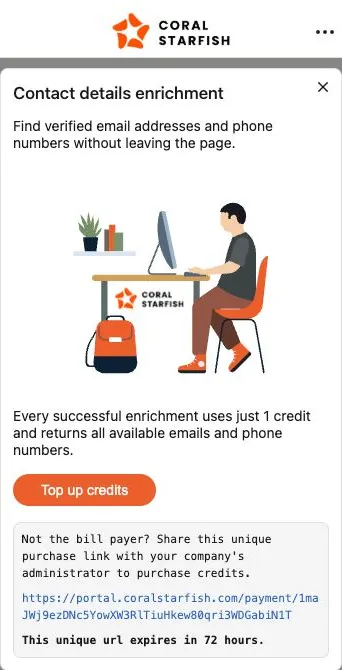
To solve this, when a user tries to enrich a contact and doesn’t have enough credits, they’re immediately informed and given the option to purchase more.
There is one problem to this that we had to consider, the person using Coral Starfish and receiving this message, might not be the person responsible for paying for it.
For example, a recruiter might need more credits to continue their work, but their manager or someone in the finance team might be responsible for making purchases.
Rather than expecting the recruiter to contact us, we’ve provided an option to copy a purchasing link and share it with a colleague.
That colleague can then select a credit bundle and complete the purchase, even if they don’t use the Coral Starfish extension themselves.
Once payment has been completed, the purchases credits are immediately available for all its users. There’s no need for us to get involved, and customers don’t need to wait for someone from our team to be available.
We’ve already had several customers purchase credits this way without needing any assistance, which is encouraging and suggests the process is working as we’d hoped.
Keeping things secure
Of course, making something easy to use is only part of the consideration, particularly when payments are involved.
Privacy and security by design are non-negotiable principles for us, so the solution had to be as secure as possible without introducing unnecessary complexity for customers.
We decided to use Stripe to handle payments, which means customers enter their card details directly into Stripe’s checkout rather than providing them to Coral Starfish.
We don’t receive or store any card details, which is an important distinction and means those details wouldn’t be exposed if our own systems were compromised.
We also had to think about how people could access the purchasing pages, particularly because the person making a purchase might not actually be a user of our product, for example someone in the finance department.
To handle this, we use secure, time-limited links that expire, rather than introducing another account and password that customers would need to manage.
There’s quite a lot happening behind the scenes to make the purchasing process work securely, including confirming payments and allocating credits automatically.
We’ll cover some of those considerations in more detail in another article.

Continuing to listen after launch
Although the pilot programme gave us the confidence to launch the feature, we certainly don’t consider it finished.
We’re continuing to ask customers for feedback, and we’ve already received some interesting suggestions about how we could improve things further.
For example, credits are currently shared across everyone within a company. One customer has suggested that it might be useful to allocate credits to individual users instead.
Another suggestion from an Exec Search Firm using our Bullhorn integration was to give companies more control over who can purchase credits, rather than allowing anyone to initiate a purchase, particularly where organisations want to avoid unexpected spending.
These are both sensible suggestions, although we need to consider how they might affect the overall experience before deciding what to introduce.
Giving customers more control can be beneficial, but we also don’t want to make things unnecessarily complicated for everyone else.
We’re also in the process of adding email notifications to let customers know when their credits are running low or have run out, so more credits can be purchased before they run out.
As with the pilot programme, we’ll continue listening to feedback and using it to help decide what we should work on next.
Customer experience is more than just the interface
When people talk about customer experience, it’s easy to focus on how software looks or how many clicks it takes to do something. Those things are important, but we think there’s quite a bit more to it.
It’s also about understanding how customers work, recognising that different people within a business have different responsibilities, and trying to remove problems before they become frustrating.
Sometimes that means making something quicker. Other times it means providing more flexibility, or reconsidering a decision because a customer has explained something we hadn’t fully considered. One of our long-term clients is reaping the rewards from our continued developments…
“Coral Starfish has been a game-changer for Fraser Dove International. Since integrating it with Bullhorn, we’ve seen a significant improvement in efficiency, streamlining workflows and enhancing visibility across our recruitment processes. The seamless LinkedIn integration has been invaluable, making it an essential tool for our consultants. Elliott and the team have provided exceptional support, responding swiftly to our needs and continuously refining the software to align with our business requirements.”
Our contact details enrichment feature is a good example of how involving customers can influence several different parts of a solution, from the technology we choose to the way we present information and even how customers purchase it.
We’re pleased with what we’ve launched, but we’re equally interested in what we can learn from customers now they’re using it.
We don’t expect to get every decision right the first time, and that’s one of the reasons we think continuing to involve customers is so important.